

Dicky ticker
The AGA’s prediction markets tax-loss ticker comes in for criticism

AGA ticker points to lost taxes; predictions critics point to lack of evidence.
In +More Predictions: A Saylor bitcoin market is difficult to resolve.
The EU raises the prospects of a gambling tax.
India: Court ruling could be existential for gaming sector.
Yaspa is an award-winning fintech delivering personal intelligence through instant payments. Powered by open banking and AI, Yaspa’s Intelligent Payments combine Pay by Bank transactions with verified customer insights to protect players and power safer gambling. The platform also provides a full suite of payment and account verification services, using pan-operator financial insights and bank-grade security to reduce friction and fraud, strengthen compliance and improve payments performance. Yaspa operates across the UK, Europe and the US, and is regulated by the UK’s Financial Conduct Authority.
Learn more at www.yaspa.com
Contestable
Tick-tock: The American Gaming Association (AGA) has escalated its campaign against prediction markets, claiming the rapidly expanding sector has already cost US states and tribal governments more than $1bn in lost gaming tax revenue since the start of 2025.
The trade body unveiled a ticker on its website to illustrate the claimed loss of tax revenue.
But it drew immediate criticism from a rival trade body for the prediction markets operators.
In an X posting, the Coalition for Prediction Markets wrote: “Error 404: sources not found.”
Beyond help: AGA president and CEO Bill Miller said the issue extends beyond commercial operators and directly impacts public finances and tribal communities that rely on gaming revenues to fund essential services.
Speaking on CNBC, Miller argued that states and tribes are being deprived of revenue that would otherwise support schools, infrastructure projects and community programs.
He also pointed to the growing coalition of state attorneys general challenging prediction market operators, noting that regulation of financial markets by the CFTC does not automatically grant authority over sports wagering.
“It’s not just our concerns,” he said. “It’s not about the AGA or the gaming industry, it’s about states and tribes that are losing literally $1bn in state and tribal revenue.”
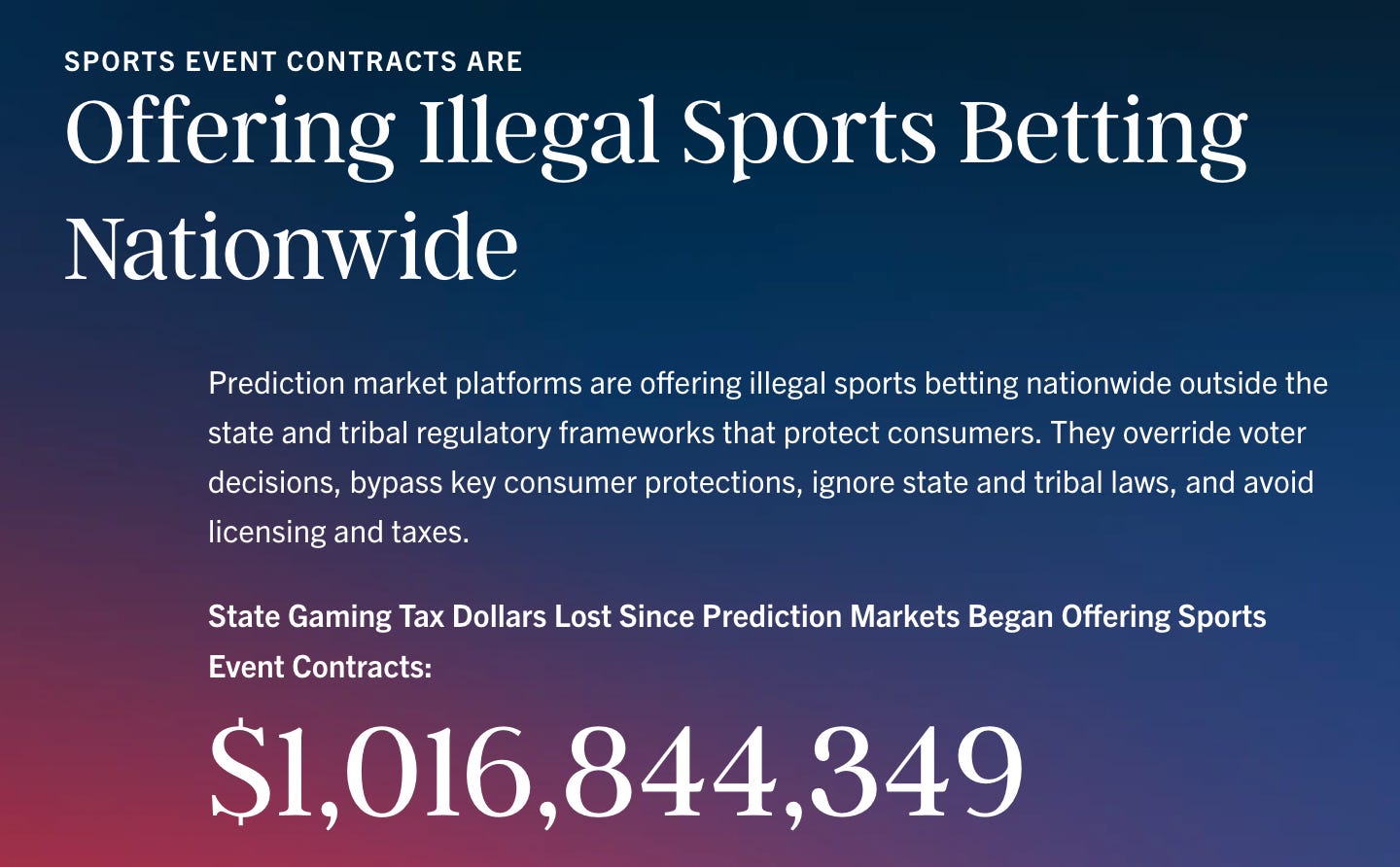
But does it add up? The AGA’s estimate appears to be based on applying existing state and tribal sports-betting tax rates to prediction market sports contract volume.
But critics have questioned the methodology, arguing it assumes every dollar wagered through prediction markets would otherwise have been placed with a licensed sportsbook.
Moreover, some prediction market users may not participate in traditional sports betting at all, while others are located in jurisdictions without legal sportsbook access.
Here’s what you could have won: The tax argument marks a notable evolution in the industry’s opposition strategy. While much of the debate to date has focused on whether sports event contracts constitute gambling or financial products, the AGA is increasingly framing prediction markets as a threat to state finances and tribal gaming compacts.
That message is likely to resonate with lawmakers facing budget pressures and with tribal governments that depend heavily on gaming revenue to fund healthcare, housing, education and other public services.
Tribal fears: The issue has become particularly sensitive for tribal operators, which have repeatedly argued that prediction markets are circumventing a carefully negotiated framework of federal, state and tribal gaming regulation established under the Indian Gaming Regulatory Act.
Several tribes have already joined legal actions against prediction market operators, while the Indian Gaming Association has made the issue one of its primary federal policy priorities.
Make friends, influence people: With prediction market litigation continuing across multiple states and the CFTC still considering its long-term approach to event contracts, the AGA’s $1bn and climbing figure appears designed as much to influence policymakers as to quantify the market’s impact.
Whether regulators ultimately accept the calculation may be less important than the broader political message.
Prediction markets are increasingly being portrayed not simply as a competitive threat to sportsbooks, but as a direct challenge to state and tribal gaming revenue systems.
+More predictions
North Carolina: Gov. Josh Stein has signed an executive order prohibiting state employees from using nonpublic information obtained through their jobs to trade on prediction markets, such as Kalshi and Polymarket. The order extends existing state ethics rules and also bars employees from participating in contracts directly related to their agency’s work or using state resources to access prediction markets.
Kalshi has entered the federal government’s lawsuit against Wisconsin, seeking to join the DoJ and the CFTC as a plaintiff in the case. The company said Wisconsin is wrongly trying to apply state gambling law to event contracts traded on a federally regulated exchange, despite the CFTC’s claimed exclusive authority under the Commodity Exchange Act.
The answer’s maybe: A dispute over an $85m Polymarket contract has reignited concerns about how the platform resolves contested markets. The market asked whether Michael Saylor’s Strategy would sell any bitcoin by May 31. Although the company later disclosed in an SEC filing that it sold 32 BTC between May 26 and 31, the filing itself was not released until June 1, creating ambiguity over whether the market should resolve ‘yes’ or ‘no.’ The disagreement has been escalated to a vote among holders of UMA tokens, whose oracle system is used by Polymarket to settle disputed outcomes.

Fresh off the back of our U.S. focused webinar “Beyond the Month Webinar 2026: The Future of Player Protection in the US: Trends, Innovations, and Challenges”, the Mindway AI team will be attending some key upcoming North American events.
International Association of Gaming Advisors (IAGA) International Gaming Summit, Florida, June 2-4
SBC Summit Americas, Florida, June 9-11
We look forward to connecting with industry leaders at these events. Drop us a message to arrange a meeting contact@mindway.ai
+More
Sports integrity: Federal prosecutors in the Eastern District of New York have added a sports bribery charge to the case against former NBA player Terry Rozier in a superseding indictment, alleging he accepted a $100,000 bribe to underperform in a 2023 game for the Charlotte Hornets so gamblers could win on player prop unders. Rozier, who has already pleaded not guilty to wire fraud and money laundering conspiracy charges, was described by his lawyer Jim Trusty as the subject of “new charges, new theories, but all just a sad effort to make something stick.”
File under ‘he would say that, wouldn’t he’: The chair of Philippines-listed online gaming operator and provider DigiPlus, Eusebio Tanco, said the country’s authorities should consider requiring all licensed online gaming operators to be publicly listed. He said the decision would help create a more competitive environment in the country while also keeping players away from the black market.
Star fine: The New South Wales Independent Casino Commission has fined Star Entertainment A$10m ($7.2m) over a series of compliance and regulatory failures at The Star Sydney, while also requiring the operator to allocate an additional A$5m towards financial crime risk management upgrades.The penalties relate to systemic failures in AML controls, customer due diligence processes, patron welfare measures and exclusion procedures.
EU gambling tax
EU must be kidding: The European Commission is assessing the introduction of a new EU-wide tax on online gambling as part of a broader effort to fund the bloc’s next long-term budget, with forecasts suggesting the measure could generate approximately €13.3bn over the 2028-2034 budget cycle.
According to documents seen by Politico, the proposed gambling levy forms part of a wider package of potential new EU revenue sources that also includes taxes on digital services and cryptocurrency transactions.
The proposals are being discussed as Brussels seeks additional funding streams to support a budget expected to approach €2trn, while also helping finance repayments linked to the EU’s post-pandemic recovery borrowing.
Best ideas: The Commission estimates that a 3% tax on the net turnover of online gambling operators could raise around €1.9bn annually.
While still at an early stage, the proposal has reportedly attracted preliminary support from several member states.
It makes it one of the more viable new revenue options currently under consideration.
The idea comes amid broader discussions within the European Parliament over new “own resources” for the EU budget. The politicians have increasingly explored sector-specific levies targeting industries that operate across borders and benefit from the EU single market.
Alongside gambling, proposals include a 3% digital services tax that could generate around €5bn annually.
The EC is also looking at a crypto transaction tax that could contribute €3bn-€4bn per year.
Hurdle rate: Despite gaining traction, the gambling tax faces significant political hurdles. Any new EU-wide tax requires unanimous approval from all 27 member states, with Malta expected to be among the strongest opponents given the importance of the online gambling industry to its economy.
Industry stakeholders have also warned that additional taxation could increase pressure on already heavily regulated operators and potentially strengthen black-market competition.
The proposals are expected to remain a key topic in negotiations over the EU’s 2028-2034 Multiannual Financial Framework.
Member states are aiming to reach a broader budget agreement by the end of 2026.

GuardDog, powered by Underdog, is a pioneering investment fund dedicated to fostering innovation in responsible gaming.
GuardDog supports and accelerates early-stage startups focused on building new and creative solutions to address problem gaming and further responsible gaming.
Ready to be one of the underdogs of responsible gaming?
Visit to apply: https://underdogfantasy.com/guarddog
Indian tax blow
Ouch: India’s online gaming sector is facing a potentially existential tax and regulatory crisis after the country’s Supreme Court ruled that real-money skill-based games should be treated as betting and gambling for goods and services tax (GST) purposes.
The court also upheld the retrospective application of a 28% GST on the full value of player stakes rather than operator revenue.
The ruling represents a decisive victory for Indian tax authorities and revives backdated tax demands estimated up to $14bn.
Delta force: However, the listed Delta Corp told investors this week that its preliminary assessment of the judgment indicates that GST should be calculated on the amount received from players for casino chips sold rather than on the gross value of every wager placed.
The company described this interpretation as a “favorable outcome” and noted that it has already been using this methodology since the revised GST framework came into force in October 2023.
According to Delta, the same basis would now apply retrospectively to the period between July 2017 and September 2023.
Irrelevant: At the heart of the dispute was whether GST should be levied on GGR or on the total value of deposits and contest entry fees staked by players. The industry argued that taxing the entire pooled amount was commercially unsustainable and inconsistent with long-standing judicial distinctions between games of skill and games of chance.
The Supreme Court rejected those arguments, however, ruling that once money is staked on an uncertain outcome, the distinction between skill and chance becomes irrelevant for GST purposes.
The court also held that 2023 GST amendments were merely “clarificatory” rather than creating a new tax regime, allowing authorities to pursue claims dating back before October 2023.
While substantial uncertainty remains pending detailed implementation guidance and further legal proceedings, Delta’s interpretation suggests the ruling may ultimately reduce the industry’s exposure compared with worst-case projections.
Calendar
Jun 4: Gaming in Holland, Amsterdam
Jun 10-11: Player Protection Symposium, Fort Lauderdale
Jul 22-24: NCPG Annual Conference, Nashville
Nov 10: Gaming in Germany, Berlin

Increase Operator Margins with EDGE Boost Today!
EDGE Boost is the first dedicated bank account for bettors.
Increase Cash Access: On/Offline with $250k/day debit limits
No Integration or Costs: Compatible today with all operators via VISA debit rails
Incremental Non-Gaming Revenue: Up to 1% operator rebate on transactions
Lower Costs: Increase debit throughput to reduce costs against ACH/Wallets
Eliminate Chargebacks and Disputes
Eliminate Debit Declines
Built-in Responsible Gaming tools
To learn more, contact Matthew Cullen, chief strategy officer on Matthew@edgemarkets.io
An +More Media publication.
For sponsorship inquiries email scott@andmore.media.
