

Overexposure
Gambling’s ubiquity counts against it with the public, says report

More In Common shows UK public turning against gambling.
In +More: Polymarket to end ‘token adjudication.’
Il wind: Chicago levy triggers operator pushback.
AGA advisor Christie takes on prediction markets.
Yaspa is an award-winning fintech delivering personal intelligence through instant payments. Powered by open banking and AI, Yaspa’s Intelligent Payments combine Pay by Bank transactions with verified customer insights to protect players and power safer gambling. The platform also provides a full suite of payment and account verification services, using pan-operator financial insights and bank-grade security to reduce friction and fraud, strengthen compliance and improve payments performance. Yaspa operates across the UK, Europe and the US, and is regulated by the UK’s Financial Conduct Authority.
Learn more at www.yaspa.com
Everything everywhere all at once

These new puritans: Public attitudes toward gambling in Britain are shifting, not because the public has suddenly turned “puritan” but because gambling now feels impossible to ignore.
That would appear to be the message of Ending a Losing Streak, a new report from the think-tank More in Common, which was commissioned by the Coalition To End Gambling Ads (CEGA).
On the one hand, the report found that many see “nothing wrong with gambling per se.”
But the “intensity of gambling promotion and its ubiquity” have led many to worry about the effect it is having on their communities, families and children, the report concluded.
On the spectrum: In a foreword, long-standing gambling sector critic, Conservative MP Iain Duncan Smith, claimed the report showed that tougher regulation of the gambling sector would be “uncontroversial.”
He added that it would “carry strong public support from voters across the political spectrum.”
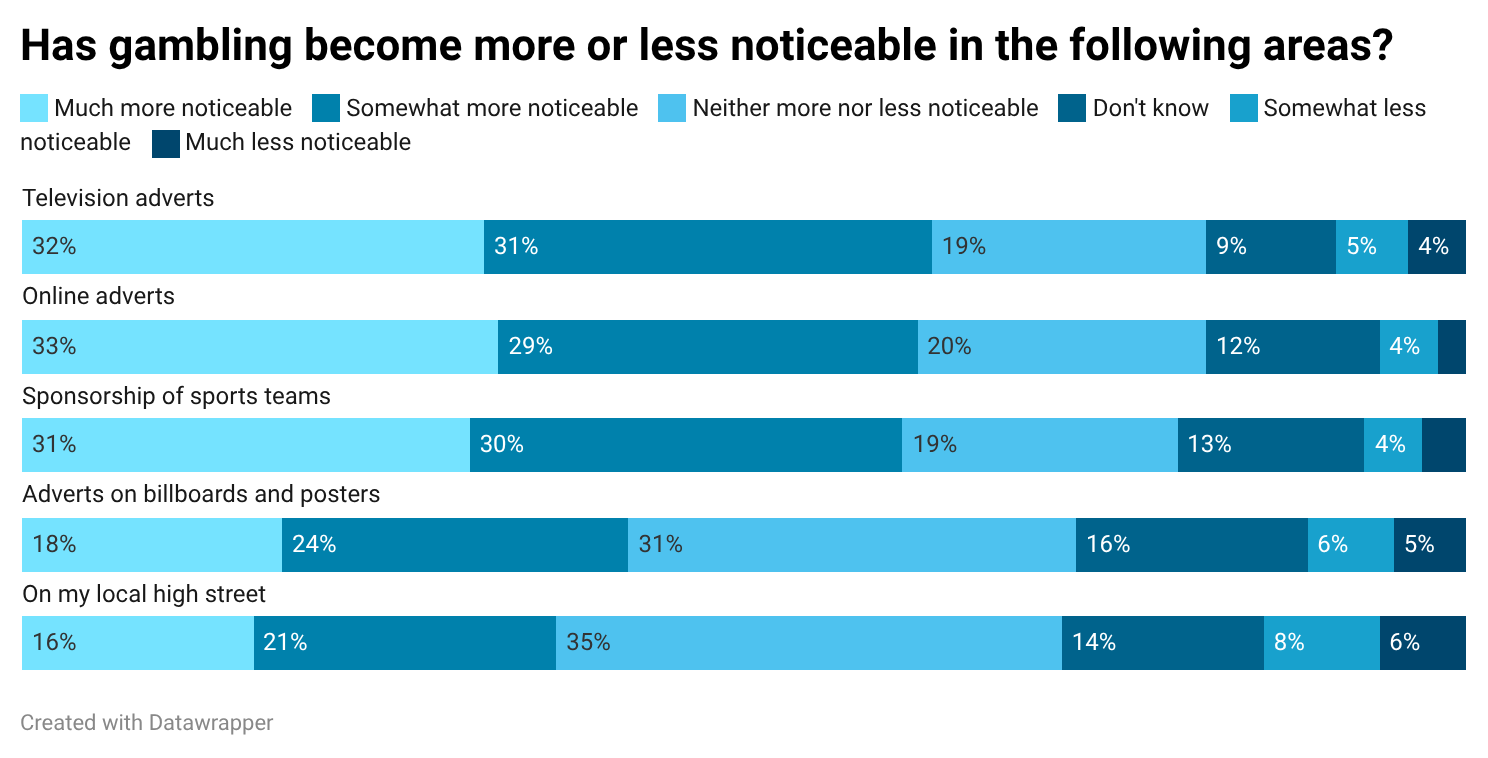
A visible problem: A single chart from the report set the scene. Asked whether gambling has become more or less noticeable across various parts of public life, the majority said it is more visible almost everywhere.
On television, 32% said gambling advertising was much more noticeable and another 31% said it was somewhat more noticeable.
Online adverts generated almost identical responses, while 61% said sponsorship of sports teams has become more prominent.
Even the high street told the same story: one in three people believed gambling has become more noticeable on their local streets.
Compulsive viewing: The report findings were more nuanced than the foreword from Duncan Smith would suggest, however. It pointed out that many Britons gamble, often harmlessly, and few want prohibition.
The National Lottery remained broadly accepted, arcades retained nostalgic appeal, and traditional betting at the races was seen as part of social life.
But the tone changed dramatically when the conversation turned to digital gambling.
People talked about speed, secrecy and the ease of losing large sums without anyone noticing.
Online slots and in-play betting apps were seen as qualitatively different from older forms of gambling: relentless, frictionless, and designed for compulsion rather than entertainment.
Not so smart: The ‘costs of convenience’ came through repeatedly. Participants described how smartphones have eliminated pause and reflection. Losing money becomes just “a number on a screen,” according to one respondent to the survey.
But the report argued that such attitudes don’t translate into simple moralism.
The public generally believed addiction was a mix of personal vulnerability and structural temptation.
But people also saw an industry optimized to extract as much money as possible, and a regulatory environment struggling to keep pace.
Wafer thin: One of the more striking findings was how little faith people have in the institutions that are meant to keep gambling safe, with only a minority expressing confidence in the Gambling Commission.
Consumer-facing campaigns about “safer gambling” often land as hollow, comparable to alcohol companies sponsoring drink-responsibility messages.
That skepticism feeds the sense that the government must step in not just with voluntary agreements, but firmer rules.
And unlike many policy debates, there is broad political alignment. Labour voters, Reform supporters, Conservative voters all leant toward tighter controls across a range of areas, from advertising to spin speeds and deposit levels.
The fun police: Advertising sits at the centre of public concern. Here the visibility chart becomes especially important. The more advertising people see, the more they connect rising exposure with rising harm.
Two-thirds believed children should not be exposed to gambling advertising at all.
And when voters were asked whether they would rather see an empty unit or a betting shop on their high street, most chose the empty shop.
The report suggested regulation is not a “war on fun” issue; rather, it sits with broader anxieties about fairness, corporate power and the fraying of community life.
For politicians, the risk lies not in over-reaching, but in appearing disengaged, the report argued.
Further reading
Direct threat: “As this latest attack on betting develops, we will discover whether some of racing’s friends are in reality its foes.” Lee Mottershead in the Racing Post.

Player Protection, Not Player Prevention
Mindway AI’s GameScanner is your virtual ally in responsible gaming, designed with expert precision to protect your players. With a detection accuracy validated by GLI, it acts like a virtual psychologist, identifying at-risk players with remarkable speed.
Our tailored algorithm, trained by leading gambling disorder specialists, learns from your player base to spot potential issues early on. In 87% of cases, GameScanner matches the accuracy of human psychologists, empowering you to intervene before it’s too late. Keep your players safe and engaged with the ultimate tool for responsible gaming.
Learn more here.
+More
Polymarket has said its US prediction-market platform won’t use the crypto-based UMA oracle system to resolve event outcomes, opting instead for an in-house resolution process where the exchange decides outcomes itself. The move, aimed at easing regulatory compliance and mirroring traditional competitors such as Kalshi, means Polymarket is leaving UMA’s token-holder voting model behind for the US launch.
Turkey: President Recep Tayyip Erdogan has vowed to restore fairness in Turkish football amid a widening betting and match-fixing scandal that has rocked the country’s leagues and authorities. Erdogan called for a full cleanup of clubs, officials, players and management to protect the sport’s integrity. He said justice must apply to all involved, voiced confidence in Turkey’s judicial process, and stressed the need to uphold football’s “noble and clean spirit.”
Brazilian taxes: President Lula has signed legislation to gradually raise sports-betting taxes, moving from 12% to 15% in 2027 and 18% in 2028. The government collected €506m in the first nine months since the regulatory framework was introduced last January. A separate proposal to tax bettors’ deposits at 15% remains under debate in Congress.
Kazakhstan plans to create new regulated gambling zones in Mangystau, Almaty, East Kazakhstan and Zhetysu to boost tourism and local economies, under recently passed legislation announced by the Minister of Tourism and Sports. New casinos will join existing ones in Borovoye and Kapchagay, with location decisions left to regional authorities. Each casino could generate roughly 2bn-3bn tenge ($3.9m-$5.8m) in annual tax revenue and about 500 jobs, with no planned tax cuts for the sector.
Stake and Drake: A new federal class-action lawsuit filed in the Eastern District of Virginia targets Stake.us, rapper Drake, streamer Adin Ross and associate George Nguyen, alleging a scheme of illegal online gambling, deceptive marketing and financial misconduct. The plaintiffs claim Stake.us, marketed as a “social casino,” effectively enabled real-money wagering and that Drake and Ross were paid to promote it, encouraging users to gamble under false pretenses. The complaint also accuses the defendants of using internal payment features to mask fund flows and seeks class certification, damages and injunctive relief.
Colombia: The government has revised its online gambling tax, now calculating the 19% VAT on GGR instead of player deposits, effective January 1, 2026, after industry pressure and negotiations. The change, described as recognizing the “mathematical reality” of gambling, aims to restore fiscal balance and support legal operators strained by the previous deposit-based model, which had dragged down market growth and investment.
Commercial
Mindway AI has signed a deal with DraftKings that will see the company integrate its neuroscience-based Gamalyze tool into the operator’s Responsible Gaming Center. Both companies said the collaboration reflects a shared commitment to research-led player protection and expanding access to tools that help customers understand and manage their gambling more responsibly.
What we’re reading
Dangerous liaisons: Dan Waugh from Regulus Partners questions whether the Gambling Commission was complicit in lobbying for higher gambling taxes.
Chicago tax
Il wind blows: After years of building out a legal sports-betting market in Illinois, a new Chicago levy on online and retail sports betting has triggered operator pushback, a lawsuit and a fast-moving response from state lawmakers.
The city’s newly adopted $16.6bn budget imposes a 10.25% tax on adjusted gross sports-wagering receipts tied to bets placed within city limits.
The tax applies to both retail sportsbooks and online or mobile bets when the bettor is physically located in Chicago.
City officials claimed the measure could raise at least $26m annually.
Layered on top of existing state taxes and fees, the effective tax rate on Chicago-based sports-betting revenue rises to roughly 32.25%.
The latest news is that licenses have been issued this week.
Look away: Operators have reared back, given Illinois already has one of the most aggressive sports-betting tax regimes in the US, including progressive state tax rates and a per-wager fee on mobile bets.
They argued the city tax further compresses margins in a market that is already heavily taxed.
DraftKings has previously called out Illinois tax pressure when introducing a transaction fee on bets placed in the state.
The Sports Betting Alliance warned the ordinance creates city-level licensing requirements without clear guidance on how online operators should comply.
Baby, what a big surprise: A coalition of sportsbooks, including DraftKings, FanDuel and BetMGM, have now filed a lawsuit challenging Chicago’s authority to impose the tax and related licensing rules.
The suit argues Illinois law gives the state exclusive authority over online sports-betting regulation and taxation.
Mayor Brandon Johnson ducked any involvement in the fray, and having neither signed nor vetoed the ordinance has allowed it to take effect automatically.
Chicago issued local licenses to major operators ahead of the January 1, 2026 effective date, prompting sportsbooks to withdraw a request for a temporary restraining order.
It better end soon: State Sen. Patrick Joyce has introduced SB 2760, which would offset Chicago’s sports-betting tax by reducing the city’s share of the Local Government Distributive Fund by the same amount.
The proposal would not ban the tax, but would neutralize its financial benefit by redistributing the revenue to other municipalities.
House Gaming Committee chair Daniel Didech has also floated legislation to bar local governments from taxing or regulating gambling under home-rule authority.
With the General Assembly set to reconvene in mid-January 2026, the Windy City tax could already be live when lawmakers debate how to respond.

GuardDog, powered by Underdog, is a pioneering investment fund dedicated to fostering innovation in responsible gaming.
GuardDog supports and accelerates early-stage startups focused on building new and creative solutions to address problem gaming and further responsible gaming.
Ready to be one of the underdogs of responsible gaming?
Visit to apply: https://underdogfantasy.com/guarddog
Christie intervention
Ello guv’nor: Former New Jersey governor Chris Christie is the latest political figure to speak out against the rapid expansion of sports prediction markets, calling them illegal, corrosive to consumer protections and a direct threat to “sports integrity.”
In an interview with CNBC, Christie, now a strategic adviser to the American Gaming Association, was blunt in his view of platforms offering sports event contracts under federal oversight.
“These markets are, bottom line, against the law, and they need to be stopped,” he said.
Christie said platforms that allow betting on sports outcomes outside state-regulated frameworks are illegal, adding that sports betting can only be offered within state licensing, tax and enforcement regimes.
Relabeling wagers as futures or event contracts does not change their legal character, he added.
Christie also rejected the notion that the Commodity Futures Trading Commission (CFTC) can regulate sports wagering through prediction markets, adding that platforms such as Kalshi are improperly leaning on federal commodities law to bypass state gaming rules. “The idea that CFTC is regulating sports is untrue, and Kalshi knows it,” he said.
School spirit: Christie warned that some emerging contract types are particularly vulnerable to abuse, and cited markets linked to whether college athletes enter the NCAA transfer portal as an example.
Such contracts, he suggested, could incentivize bribery or coercion of athletes.
“That doesn’t just distort competition, it can corrupt these athletes and change the nature of the sport,” he said.
Christie said the conflict between state gaming law and federal commodities oversight is unlikely to be resolved quickly, and that the issue would ultimately reach the US Supreme Court.
Litigation is already active in multiple states, including New Jersey, where Kalshi is operating under a preliminary injunction while the state appeals.
Malta review
Keeping busy: The Malta Gaming Authority (MGA) has published its interim performance report for January to June 2025, showing the regulator received 28 new gaming license applications and issued eight licenses. Six renewal applications were received and five renewals granted.
Criminal probity screening was conducted on 723 individuals and entities involved with license applicants.
The Supervisory Council assessed 16 license applications and rejected two for materially incomplete or misleading information.
The MGA completed seven full compliance audits and 87 thematic reviews covering compliance, player protection and sports-betting integrity, resolving 1,720 assistance requests from players and received 891 player funds reports, performing nine data extractions.
Efforts to tackle unregulated gaming led to reviews of 75 URLs, with 34 found to misuse MGA references.
The MGA also initiated and concluded 11 AML/CFT compliance examinations, and three license holders underwent remediation under FIAU directives.
The Authority issued 23 cease-and-desist letters, 15 warnings, 23 administrative penalties totaling €139,360, and cancelled one license. One appeal is pending and two older appeals were withdrawn.
In international collaboration, the MGA received 149 suspicious betting reports and shared 88 alerts with license holders.
It participated in 30 investigations, along with numerous information exchanges and cooperation requests with regulators and sports governing bodies globally.
Calendar
Jan 20: Gaming in Holland lunch @ ICE
Feb 19: SBC Digital Compliance Technology, online
Apr 28-29: Ethical Gambling Forum 2026, Leeds
May 26-28: Gambling & Risk Taking Conference, Las Vegas
Jun 4: Gaming in Holland, Amsterdam

Increase Operator Margins with EDGE Boost Today!
EDGE Boost is the first dedicated bank account for bettors.
Increase Cash Access: On/Offline with $250k/day debit limits
No Integration or Costs: Compatible today with all operators via VISA debit rails
Incremental Non-Gaming Revenue: Up to 1% operator rebate on transactions
Lower Costs: Increase debit throughput to reduce costs against ACH/Wallets
Eliminate Chargebacks and Disputes
Eliminate Debit Declines
Built-in Responsible Gaming tools
To learn more, contact Matthew Cullen, chief strategy officer on Matthew@edgemarkets.io
An +More Media publication.
For sponsorship inquiries email scott@andmore.media.
